PROJECT OVERVIEW
This project increased daily conversions and engagement by helping logged-out users understand Pinterest’s value through contextually relevant, signal-based upsells that aligned with browsing intent.
Previously, conversion upsells were generic and one-size-fits-all, lacking clear value propositions—resulting in short sessions, low conversion and engagement rates, and minimal user awareness of Pinterest’s features and benefits. I drove growth by designing a data-driven upsell strategy and framework that aligns upsell imagery, triggering, and value propositions with intent to better help users understand the unique benefits of creating a Pinterest account.
TIMELINE
Q1,2 of 2025
RESULTS
0.6% increase in conversions
~150K increase in monthly active users
ROLE
Growth designer
SUCCESS METRICS
Increase daily conversions and engagement
DESIGN QUESTION
How might we create a contextually relevant and visually captivating upsell system that helps users better understand Pinterest offerings and how features can uniquely meet their needs.
THE PROBLEM
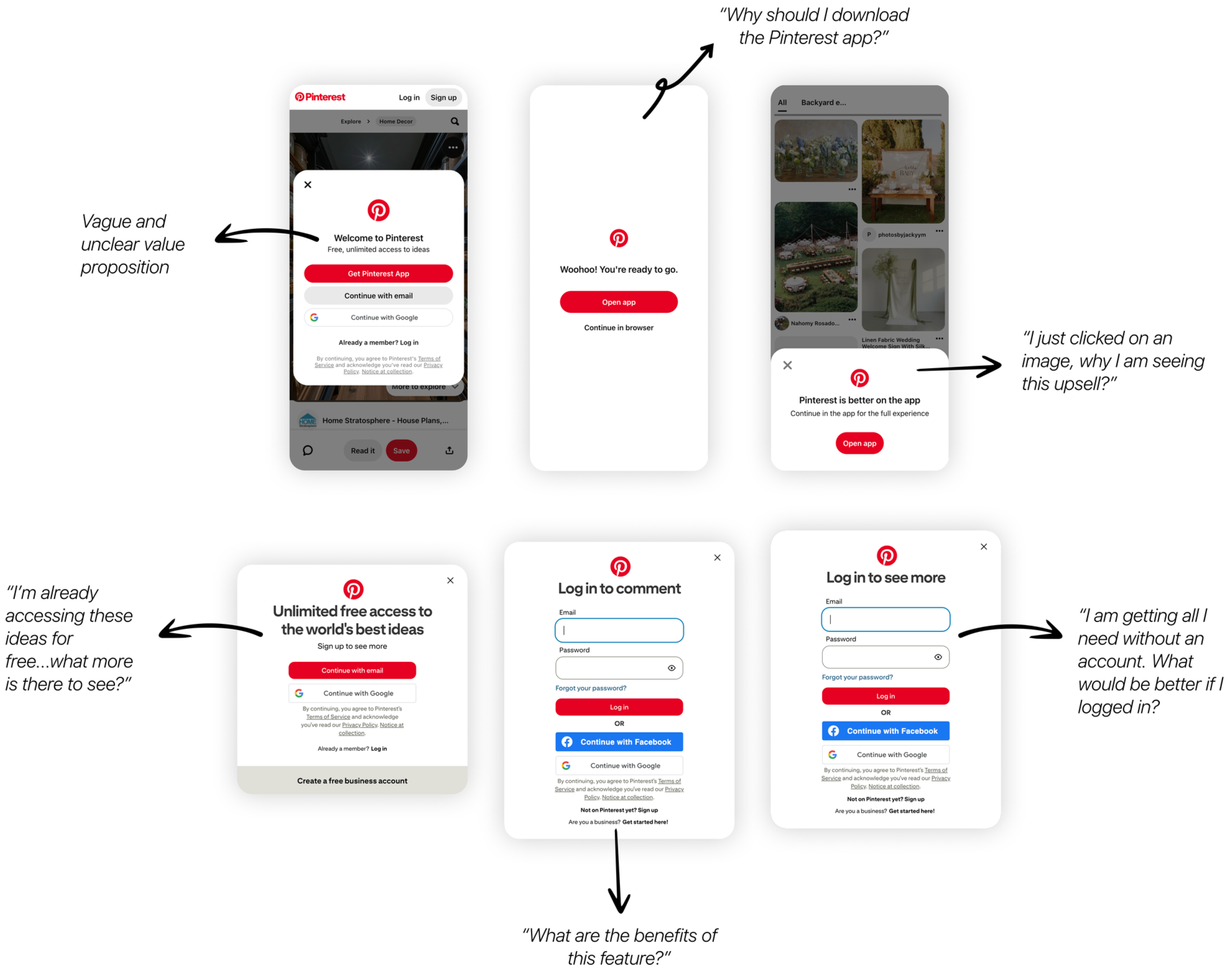
Our previous suite of upsells was disjointed and generic, lacking clear messaging that connected Pinterest's value to user intent. Many users weren't sure why they needed an account. This comprehension gap left users unaware of the great features and benefits that could help them find what they're looking for.
My goal was to build a cohesive design framework that allowed us to trigger the right upsell to the right user at the right time, helping them understand how Pinterest can meet their need.
RESEARCH
The majority of users who land on Pinterest come from search engines. These users fall into two groups:
Inspiration-oriented: Interested in collecting inspiration for their next project, meal, or event (e.g., home decor ideas)
Realization-oriented: Looking for a specific idea or product that aligns with their search keyword (e.g., living room coffee table)
In thinking of the upsell strategy, I made sure that our concepts were centered around these end goals.
In conducting qualitative research, we had three primary goals:
Identify barriers or gaps for conversion with our current upsell experience.
Assess user awareness of existing features and benefits.
Understand the effectiveness of different upsell concepts in helping users meet their end goals.
I designed exploratory concepts to understand which value propositions and strategies work to motivate inspiration and realization-oriented users to join Pinterest.
Concept one: Personalization
Help inspiration-oriented users understand that Pinterest can help them collect ideas and explore more personalized recommendations.
Scenario A: Imagine you are planning to remodel your bathroom and you land on Pinterest to collect inspiration.
Objective: Determine whether personalization is an effective value proposition for users and whether immersive and experiential upsells are effective engagement levers.
Scenario A
Concept two: Contextualized features
Help realization-oriented users learn more about the features that can be used to help them find the product or idea they are looking for.
Scenario A: Imagine you are searching for date night outfits and you land on Pinterest trying to find the perfect dress.
Scenario B: Imagine you are searching for a specific phone wallpaper and you land on Pinterest to find the idea.
Objective: Determine whether showing Pinterest features based on browsing intent is an effective value proposition for users.
Scenario A
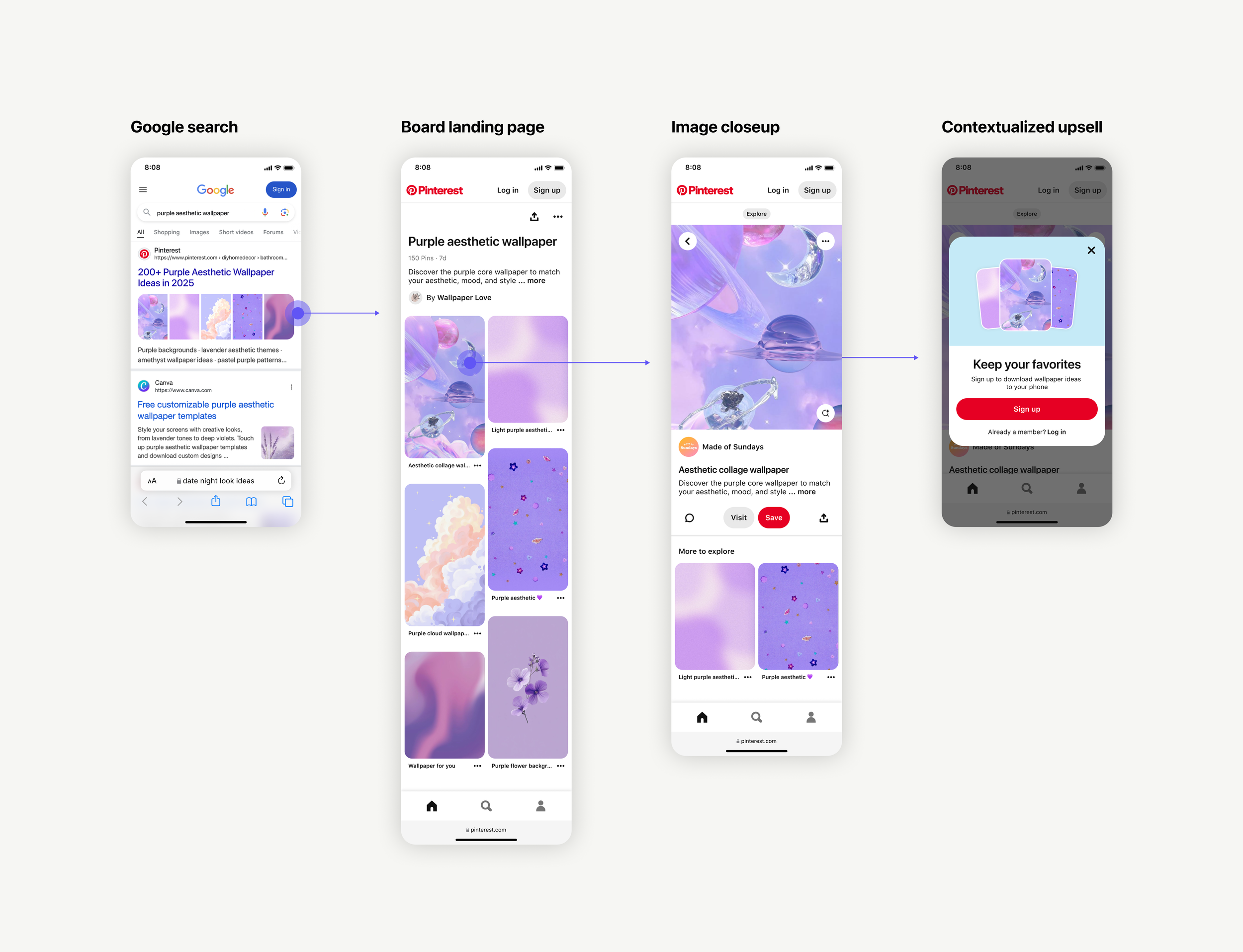
Scenario B
ANALYZE
After partnering with the research team to conduct research and test concepts, I led a brainstorming workshop with the cross-functional team to analyze data and develop our upsell strategy.
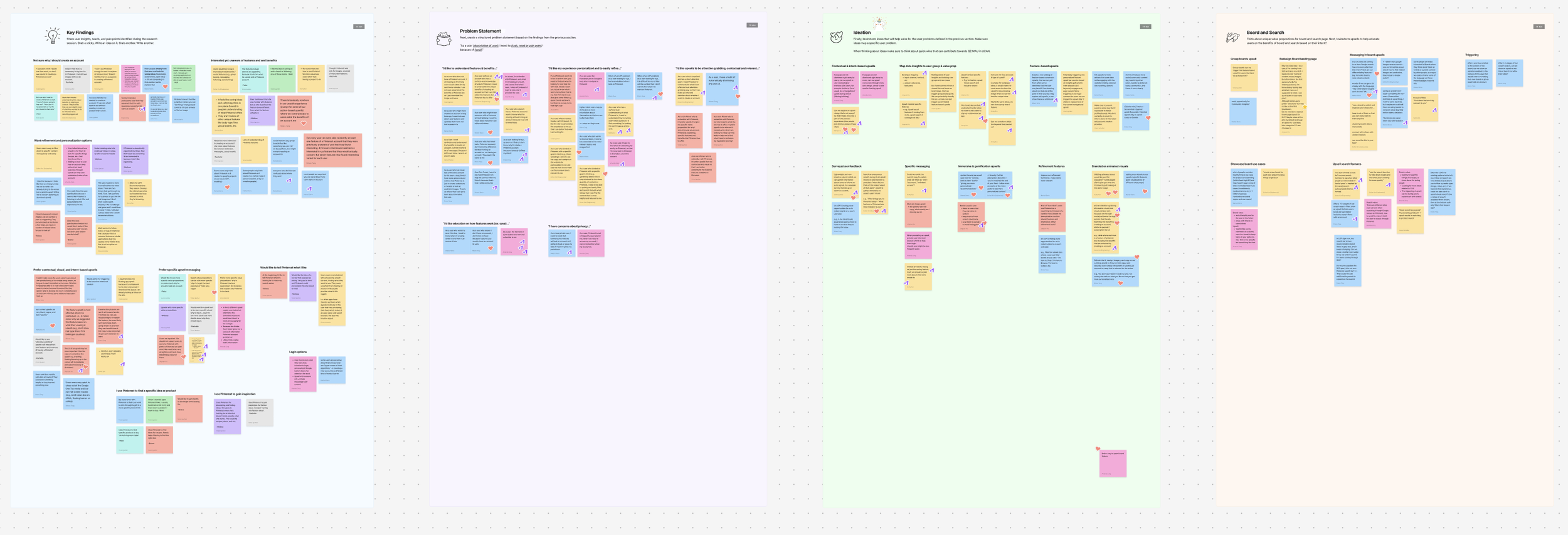
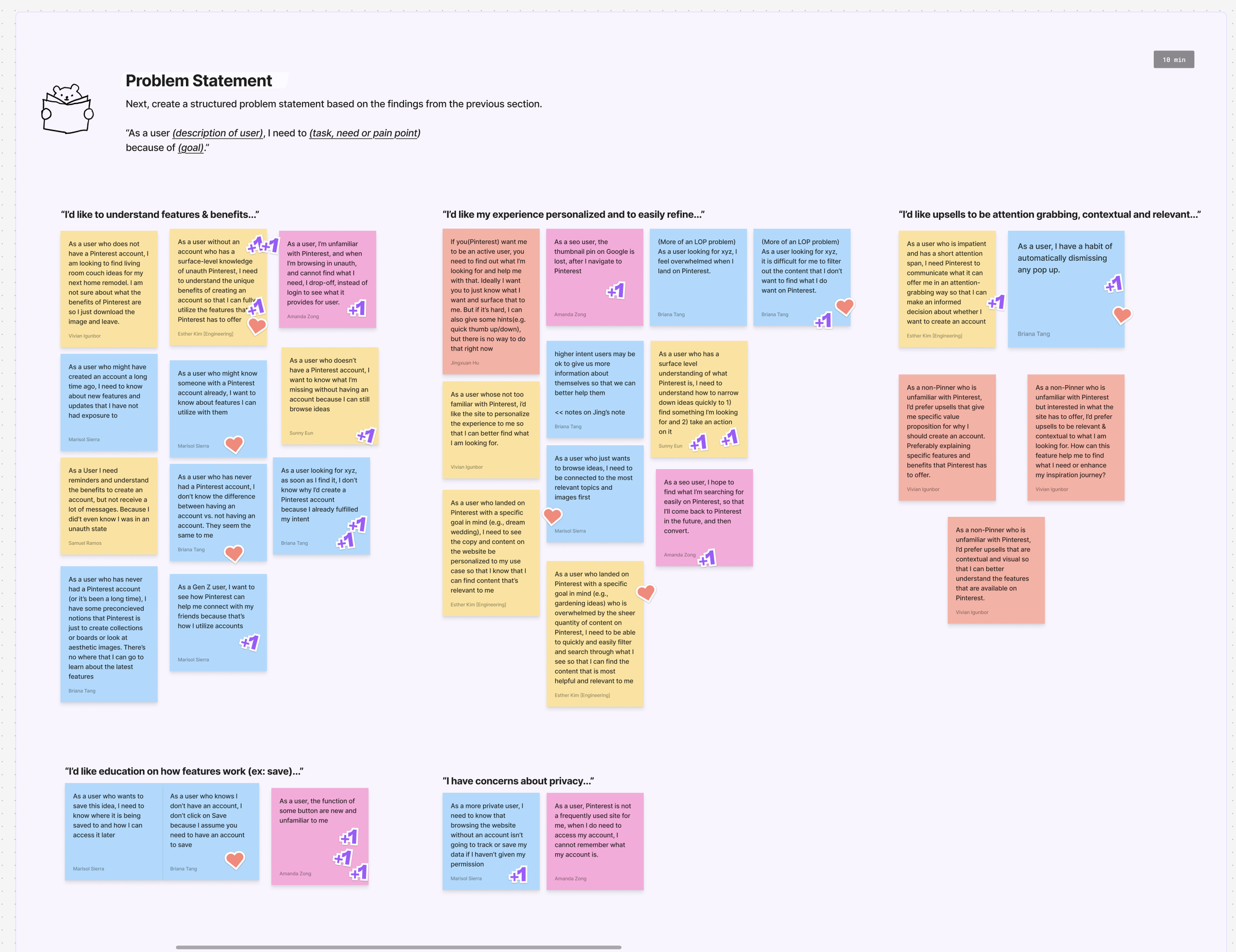
We discovered several issues with our current upsell experience:
Our current upsell experience lacks sparkle and offers poor value props: users perceive them to be forgettable, bland and vague when it comes to communicating what Pinterest is or how it can be used.
“It just feels like there’s no sparkle to it, it’s just very matter of fact ... It really doesn’t spark my imagination or my curiosity. Maybe there’s something I’m missing out on. I would like something with a bit more personality, that feels more friendly or inviting.”
“It’s a bit vague, it doesn’t really communicate how or why that would be a good idea. How that would help me make the most out of an idea. It’s not compelling enough to get you to take action”
We were able to assess users awareness of our current features and benefits:
When we showed users the features available on Pinterest, many were unaware of them but found them compelling for understanding what Pinterest was and how an account could benefit them.
“I think this genuinely a cool feature that I did not know Pinterest had. I feel like this
could be a really good pop-up, where maybe I’m looking something up like wedding and it says did you know you can pin with people? [Group boards feature]”
We identified valuable insights about the effectiveness of the new upsell concepts:
Most participants appreciated the [save tracker] concept for how it prompted them to engage in a new, more valuable way. Personalized recommendations felt like a more clear and compelling incentive.
Improving feature awareness has the potential to significantly help users understand the unique value of Pinterest.
“I just saw a Save button [in control], and I know what a Save button does. But the new messaging - ‘Save ideas to unlock recommendations’, recommendations matter to me. [Personalization concept]”
“I think this is way more effective. It tells me what signing up does, which is save my recommendations and then make additional ones. I think this is more enticing than any of the other previous things that I’ve seen about signing up for an account because it tells you exactly what it’s going to do [Personalization concept]”
“I would stop and notice that. I didn’t know Pinterest could do that ... oh, this site may be more useful than I realize. I wonder what tech they have. How else can they sort through ideas [Contextualized features concept]”
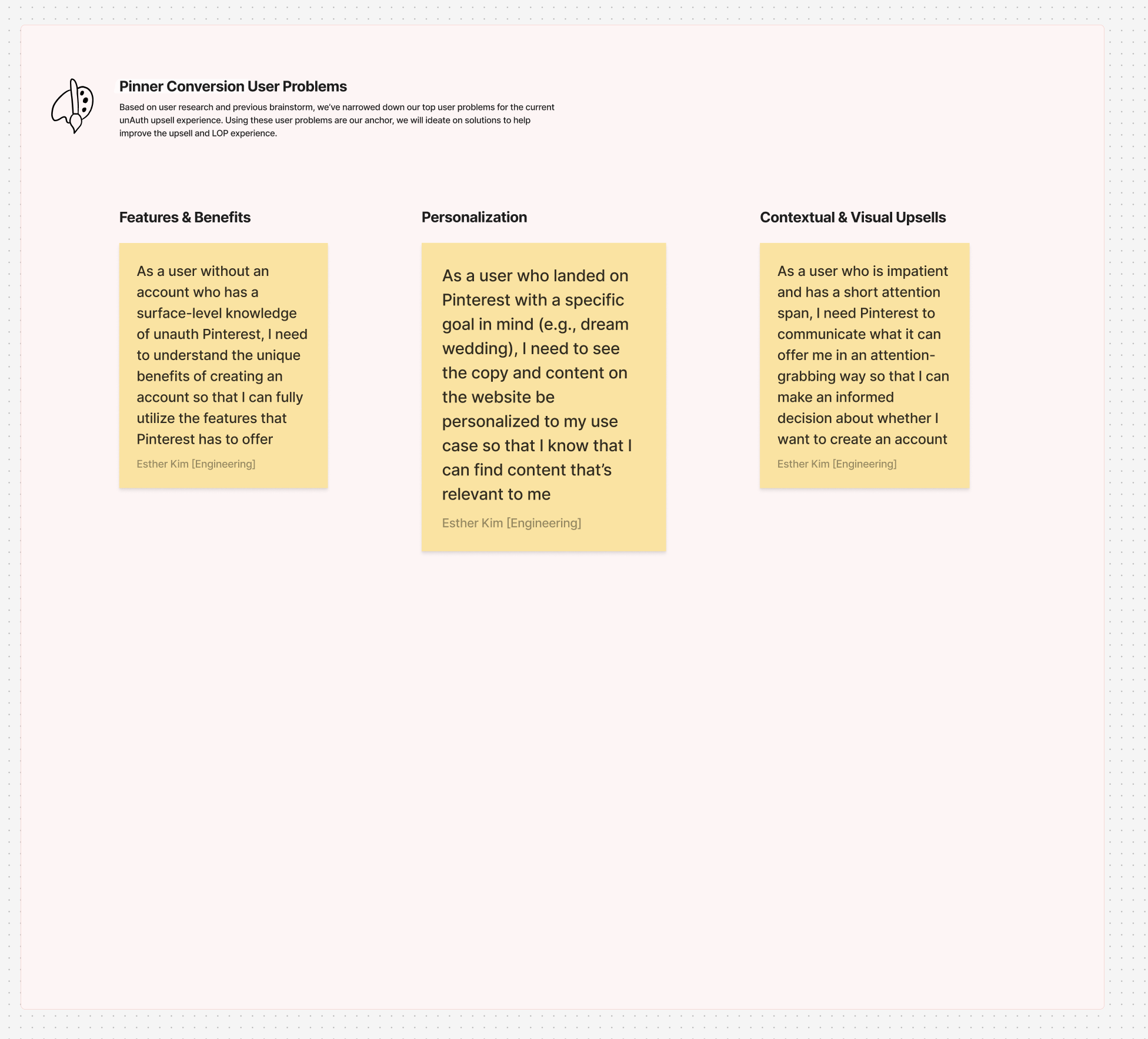
After brainstorming and analyzing the data, we identified three key opportunity areas to solve for when designing the new upsell strategy:
Create visually delightful upsells to get users excited about what awaits them with a Pinterest account.
Focus on clear and specific messaging to help users better comprehend the value of features and benefits.
Build contextual upsell journeys that tailor our upsells to users based on their signals and browsing intent, so users can imagine how Pinterest can uniquely benefit them.
DESIGN STRATEGY
I established several design goals to help address the key opportunities identified through research.
Design goals:
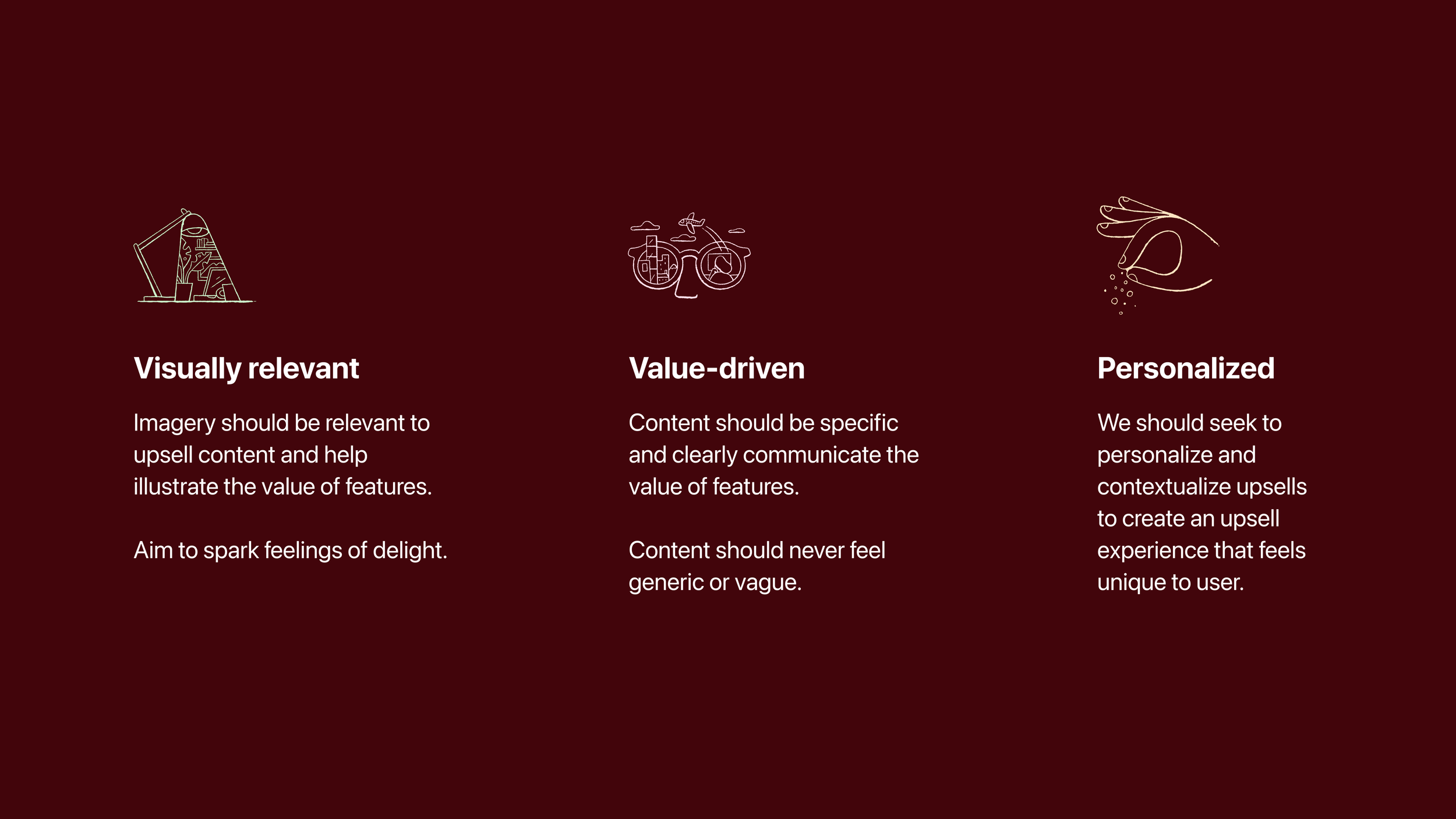
Establish design principles addressing key opportunity areas
Build a cohesive upsell framework rooted in user goals
Design principles
Upsell framework
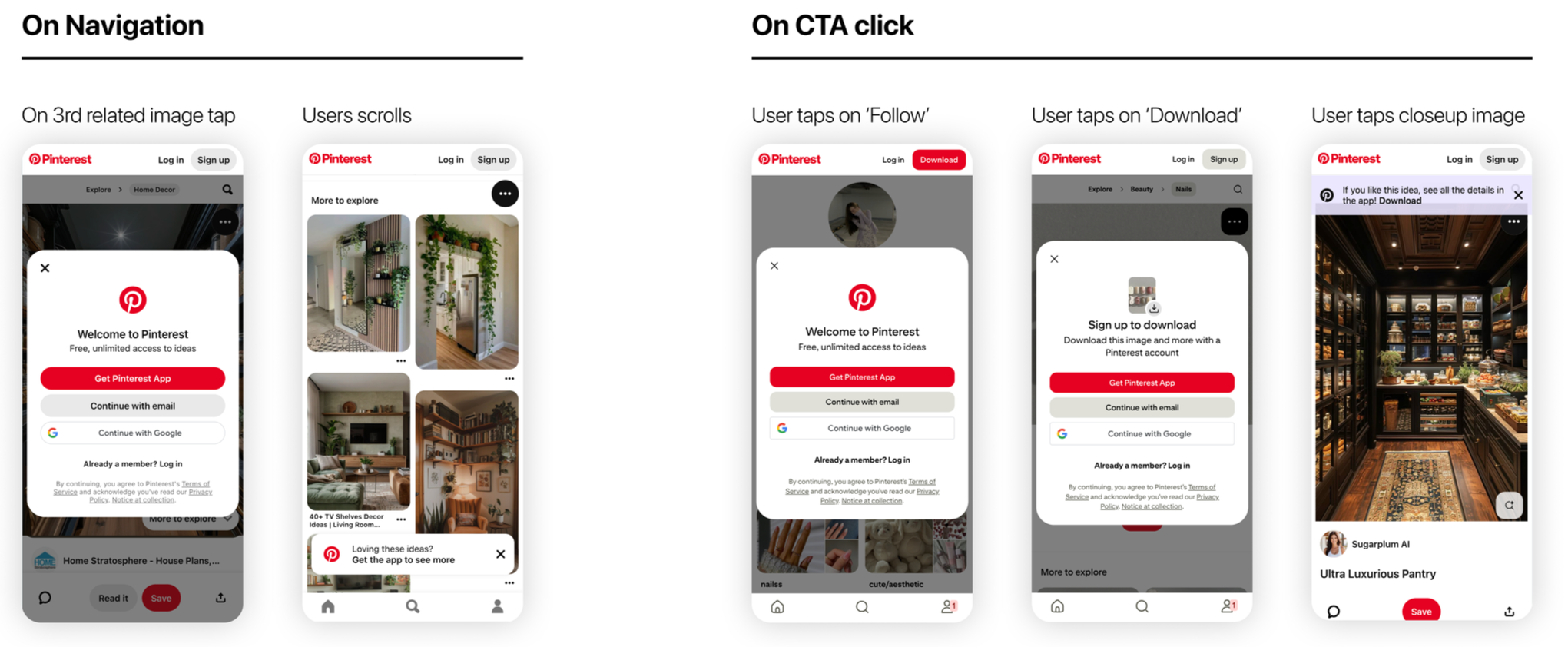
Before
In the current upsell experience, there were two core actions that trigger upsells.
On navigation (user scrolls, taps on image, or searches)
On CTA click (user taps a feature or button where an account is required for access)
These upsells were not visually cohesive, and there was no clear system to categorize, define, and meaningfully differentiate each upsell.
After
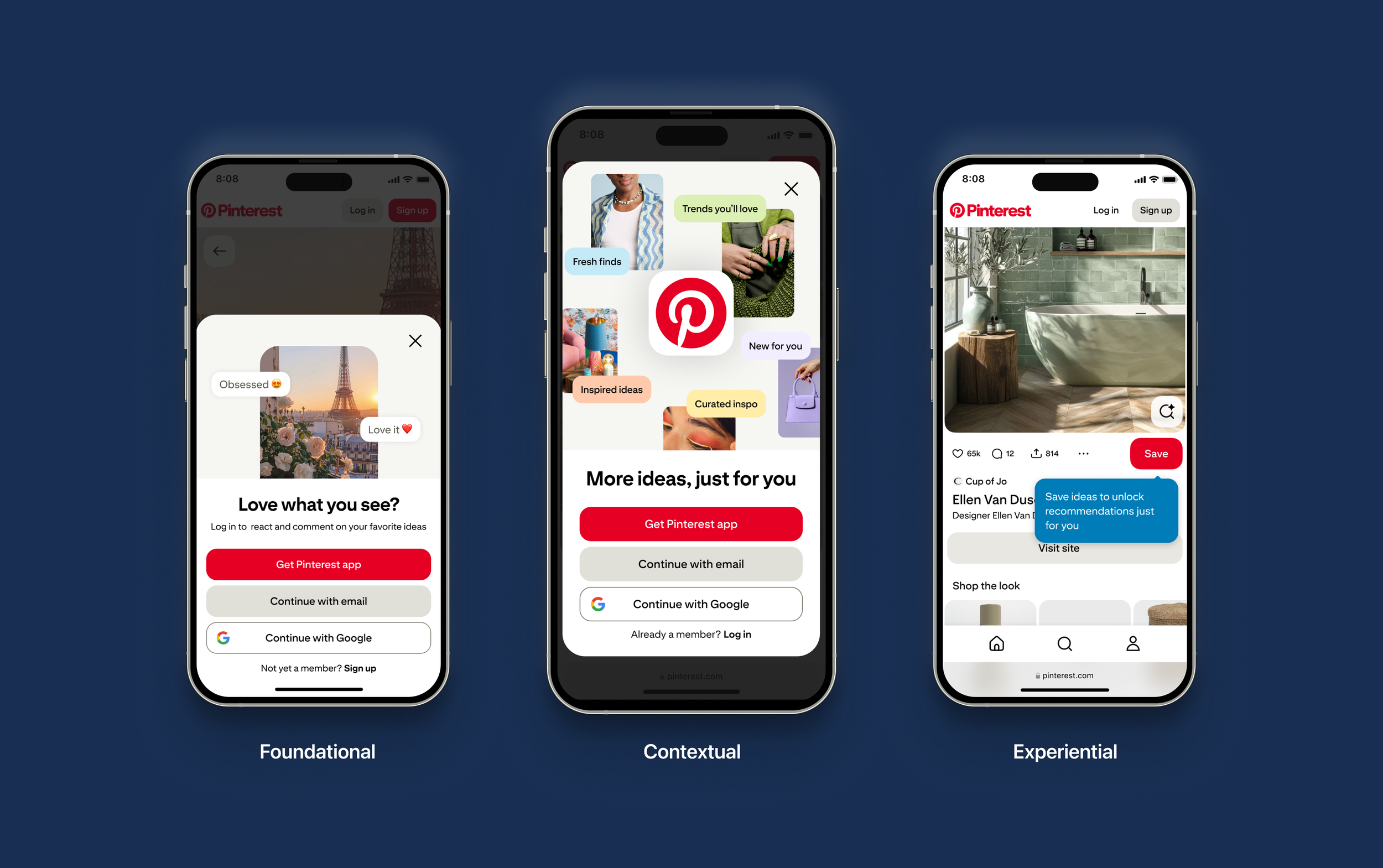
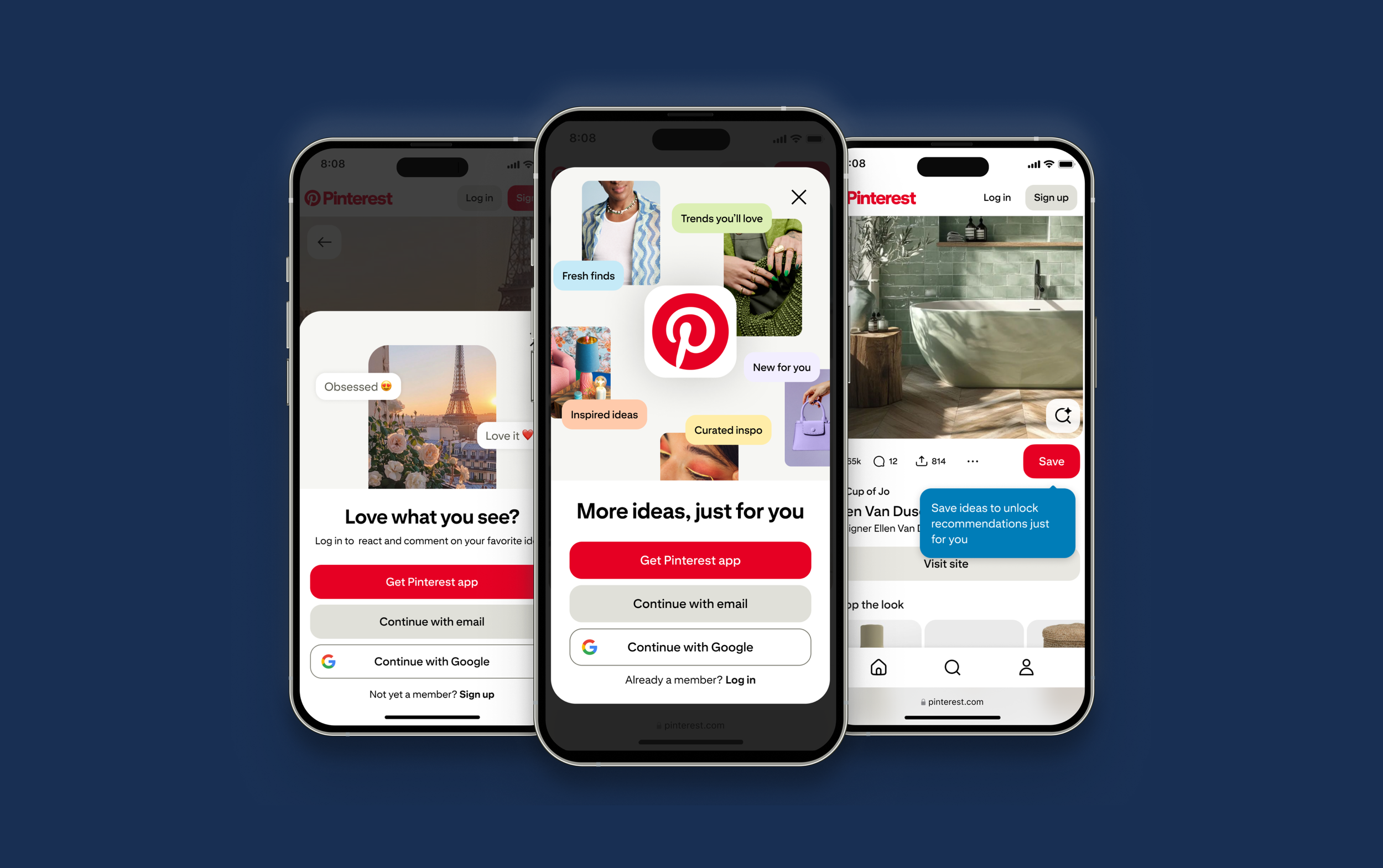
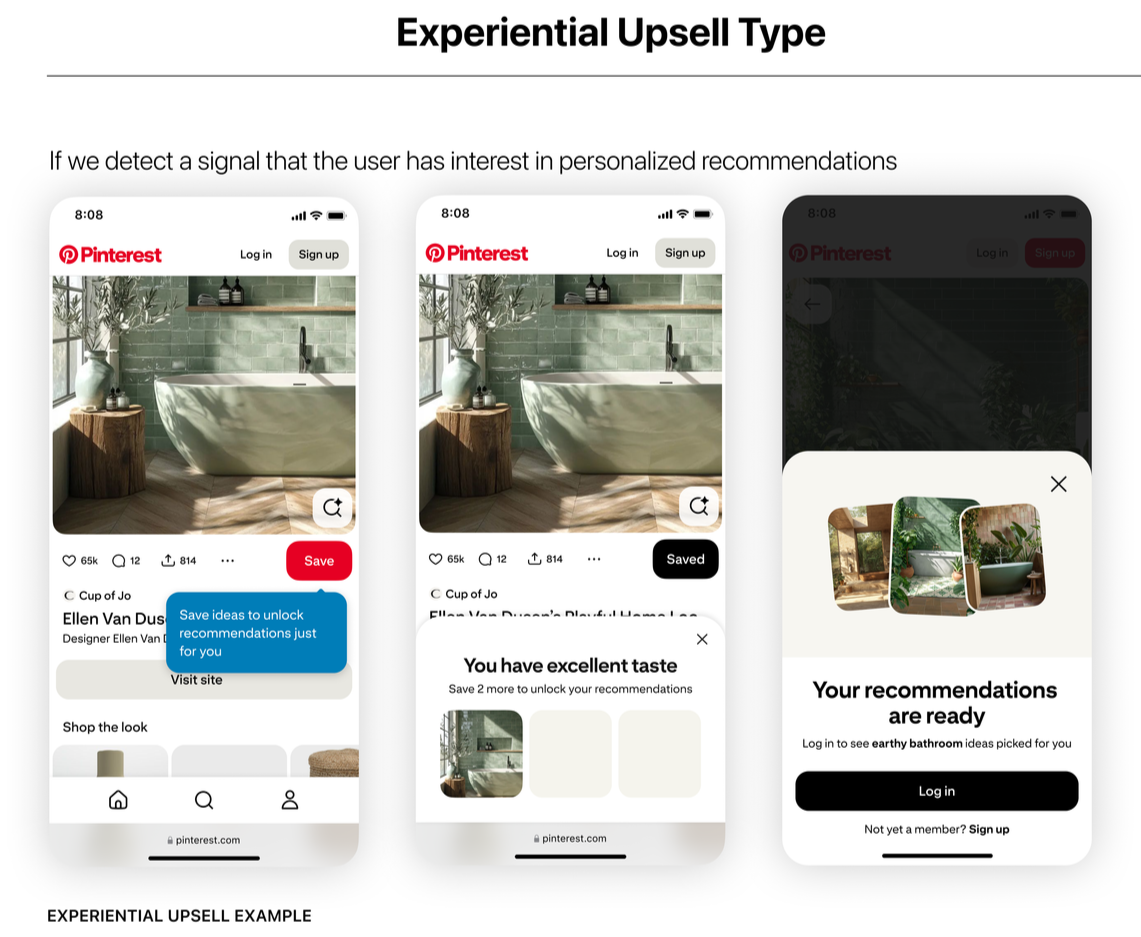
In the new framework, I categorized upsells into three distinct types with clear objectives rooted in research and visually cohesive templates. The upsells are differentiated based on user intent and data signals.
Foundational: This upsell is triggered when a user taps on a feature that requires an account. It’s designed to help the user understand the value of the feature through clear messaging and visuals. This design will replace the current upsells triggered on CTA click.
Contextual: This upsell is contextually-triggered once during the user’s session to connect them with a relevant feature or benefit based on their engagement signals. This design will replace the current upsells triggered on navigation.
Experiential: This upsell is triggered for users where we have a strong signal of their intent. It's designed to be immersive, helping them experience the value of Pinterest's features. This is a new upsell type added based on positive feedback with personalization concept tested in research.

TEST
To test the effectiveness of the new framework, we started with the contextual upsell type, as navigation-triggered upsells had the highest percentage of views and the greatest potential to drive metric improvement.
1st Experiment
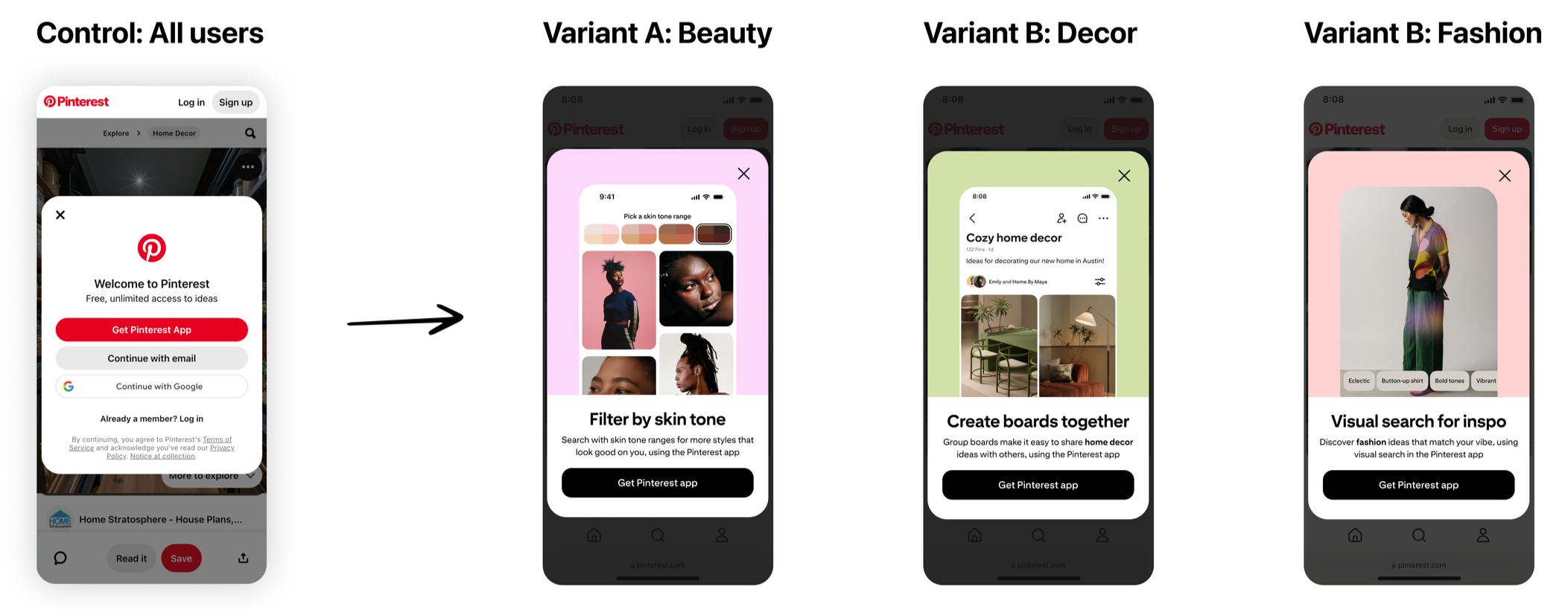
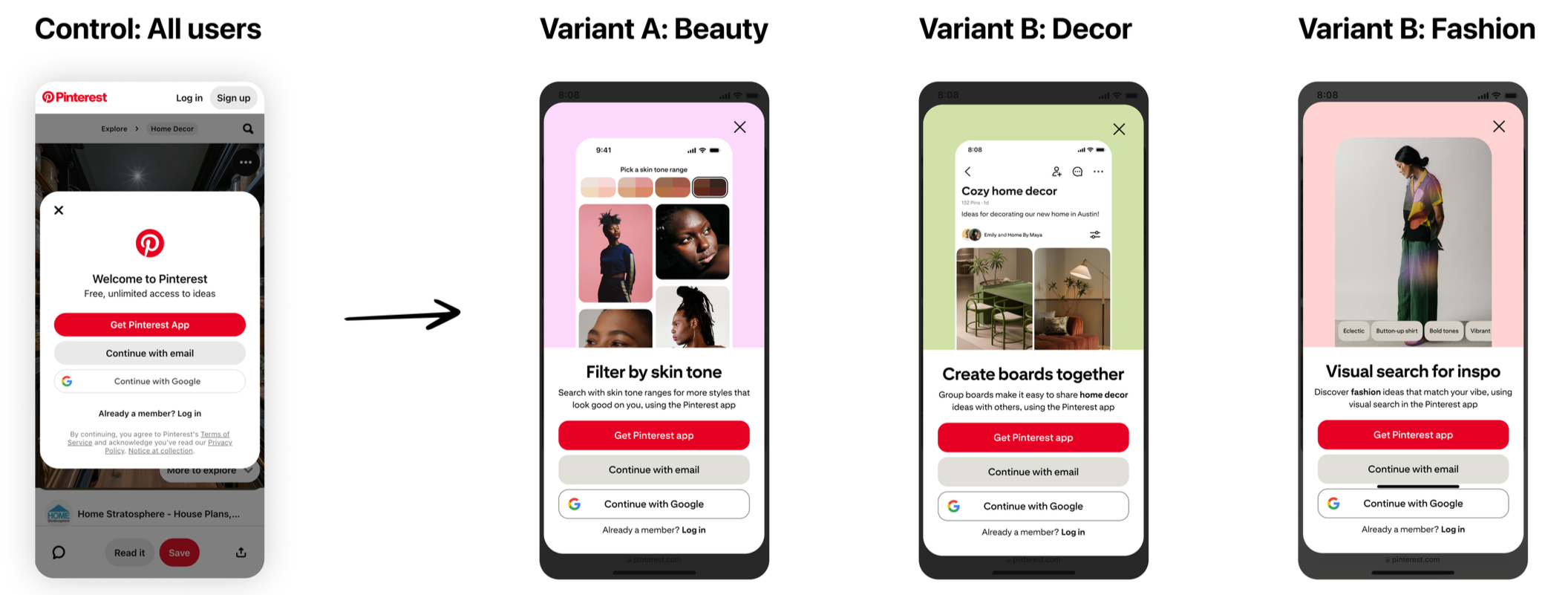
The goal of this experiment was to understand how adding contextually relevant features and improved copy would incrementally impact metrics compared to the control. We tested three variants that triggered features based on the category users were browsing (e.g., a filter by skin tone feature for users browsing beauty ideas).
The results were negative. We were surprised but quickly realized we had made too many changes. In the control, we gave users four authentication methods to log in. However, in the new experiment, we only offered one option. We retested the experiment with the authentication options in control.
2nd Experiment
When we added the authentication options from the control experience, we saw an improvement in incremental growth. There was a 0.08% increase in converted users over the control, resulting in 5,000 new users within 4-5 days. This validated our hypothesis and aligned with the research findings.
We continued testing to determine which features and benefits resonated most with users for the contextual upsell type.
3rd Experiment
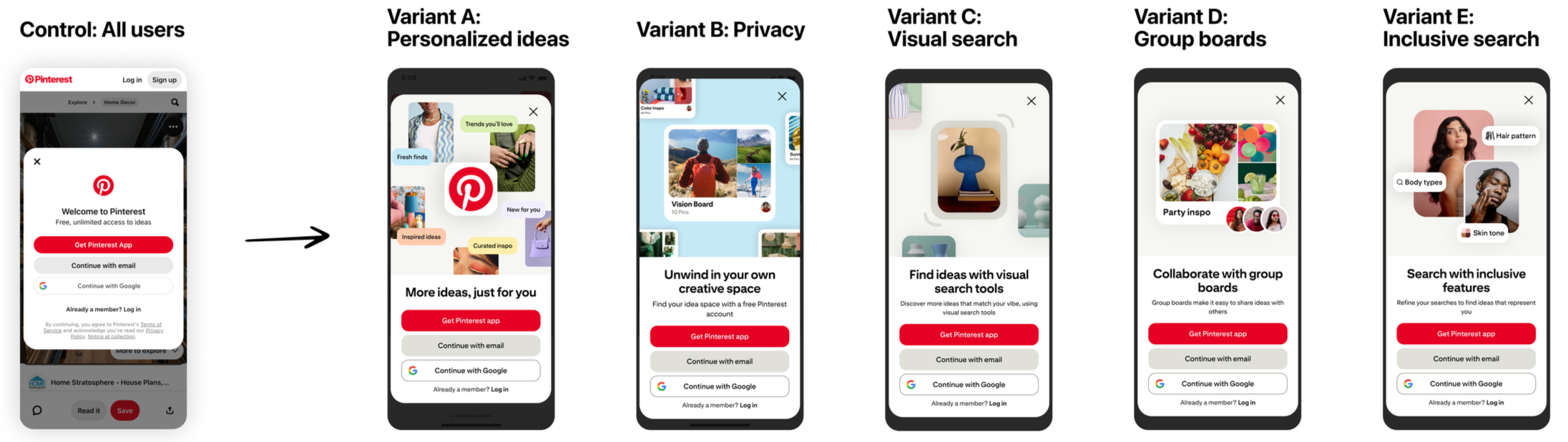
In this experiment, our goal was to determine which value proposition would resonate most with users and help them understand Pinterest's benefits. We tested two benefit value propositions (personalized ideas and personal space) and three feature value propositions (visual search, group boards, and inclusive search).
The personalized ideas value proposition performed positively across all categories, with a 0.6% increase in converted users and an estimated 150K increase in monthly active users. We concluded that users are universally interested in personalized ideas as a value proposition, regardless of the category they are browsing. We shipped this variant as the new control for the contextual upsell type.
RESULTS
This project is still in progress, and the team plans to continue iterating on the contextual upsell type to further tailor this design to users. Next year, the team plans to test the foundational and experiential upsell types.